Ant infestations across Upstate South Carolina originate largely from excessive moisture and hardwood tree canopies that border residential foundations. In older neighborhoods like North Main and Augusta Road, historic…
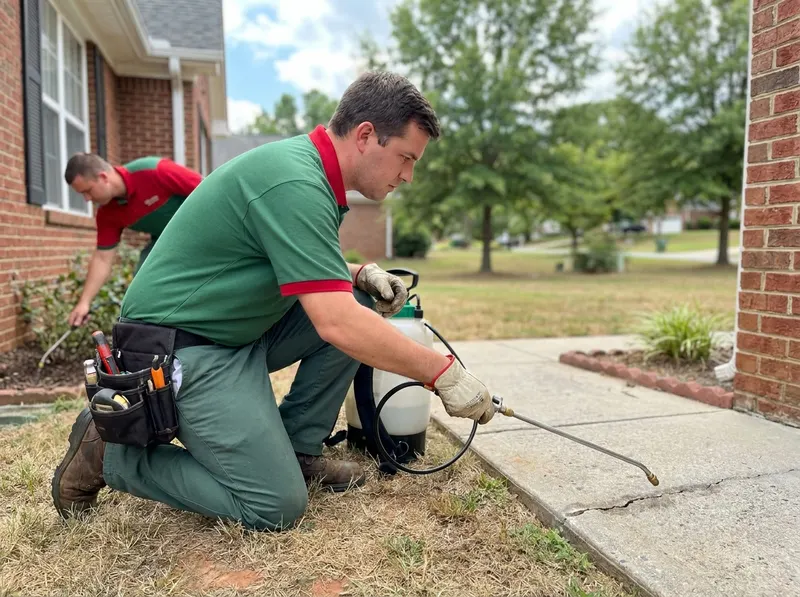
Ant infestations across Upstate South Carolina originate largely from excessive moisture and hardwood tree canopies that border residential foundations. In older neighborhoods like North Main and Augusta Road, historic oaks frequently channel wood-destroying black carpenter ants (Camponotus pennsylvanicus) into wet wall framing and subfloors. Treating carpenter ants requires locating the parent satellite nest inside crawl spaces, rather than simply spraying visible worker trails. Conventional surface insecticides repel workers, triggering colony budding, a reproductive division documented by the Clemson University Cooperative Extension where a single colony splits into multiple distinct colonies beneath baseboards. MapleHaven Exterminators applies targeted non-repellent transfer chemistry compliant with the Environmental Protection Agency, allowing workers to carry active eradication chemistry back to the reproductive queen.
Residential yards in newer developments such as Gower Estates and Botany Woods often face dense infestations of invasive red imported fire ants (Solenopsis invicta). These pests establish subterranean mounds across clay soils, posing genuine medical sting risks noted by the Centers for Disease Control and Prevention. Outdoor mound treatments utilize low-toxicity granule formulations approved under Occupational Safety and Health Administration safety protocols, preventing outdoor exposure risks for children and household pets. Concurrently, slab-built properties in Overbrook and Alta Vista routinely encounter invasive Argentine ants (Linepithema humile), which move indoors during intense summer drought periods along municipal water pipes.
The eradication process follows five distinct mechanical stages: Step 1 involves identifying the exact ant specimen using physical anatomy standards from the Entomological Society of America. Step 2 requires locating exterior moisture sources, damp wood, and utility conduit penetrations. Step 3 places non-volatile, species-specific food baits along trailing paths. Step 4 applies a non-repellent perimeter liquid barrier to foundation masonry up to 18 inches above the soil level. Step 5 monitors bait ingestion rates over a 7-day to 14-day gestation window, confirming total reproductive failure within the nest.
Every job gets a firm, written price after an on-site visit.
Tell us about your ant colony eradication job in Greenville and we'll send a clear, written quote, usually the same day.
 MapleHaven Exterminators