Nuisance bird populations in Greenville, SC, exploit elevated architectural features, creating acute property contamination and structural corrosion. The humid subtropical environment documented by the National Weather…
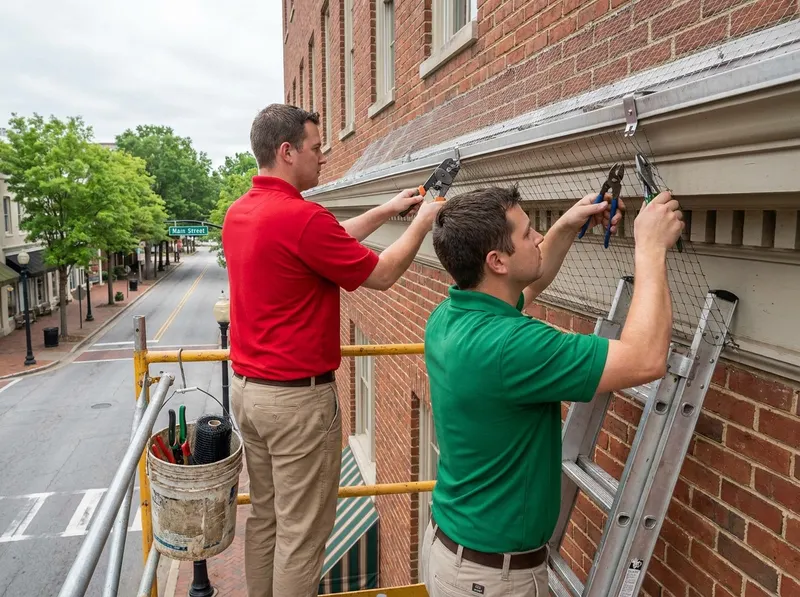
Nuisance bird populations in Greenville, SC, exploit elevated architectural features, creating acute property contamination and structural corrosion. The humid subtropical environment documented by the National Weather Service Greenville-Spartanburg office accelerates the decomposition of uric acid found in bird droppings. When concentrated on metal roofs, copper downspouts, and limestone facades, this acidic material etches building substrates and causes rapid cosmetic deterioration. Flocks roosting in attic louvers across historic residences along Augusta Road and North Main present health concerns as desiccated droppings aerosolize into HVAC returns. Biohazard regulations managed under the Centers for Disease Control and Prevention note that accumulation of dried avian waste supports fungal pathogens such as Histoplasma capsulatum. MapleHaven Exterminators installs barrier controls engineered to stop roosting without hazardous chemical dispersants or contract lock-ins.
Effective deterrence requires structural matching based on avian wing span and nesting instincts. In the commercial conversions of The Village of West Greenville and elevated loading bays near Nicholtown, open roof trusses invite feral pigeon colonization. For broad overhead spans, technicians install UV-stabilized, high-density polyethylene netting tensioned with stainless steel cables anchored directly to structural purlins. This barrier follows engineering guidelines from the ASTM International standards for building wire and mesh integrity, ensuring non-sagging spans under Upstate storm winds. For narrower surfaces, such as the decorative parapets and deep soffits in Alta Vista, Overbrook, and Parkins Mill, technicians mount optical gels, blunt polycarbonate ledges, and 316-grade marine stainless steel spike strips that eliminate landing perches.
All deterrence actions comply with the statutory protections of the Migratory Bird Treaty Act administered by the U.S. Fish and Wildlife Service, alongside wildlife preservation provisions from the South Carolina Department of Natural Resources. Federal law prohibits the active disruption, relocation, or destruction of viable eggs and nests of native migratory species, including chimney swifts, barn swallows, and purple martins. MapleHaven Exterminators carries out non-lethal, biological-timing exclusions, coordinating physical netting installation outside of regulated active brooding dates. Technicians identify species before touching a roost, distinguishing unregulated nuisance invaders, such as starlings, English sparrows, and rock doves, from protected native wildlife.
Nuisance bird deterrence operations follow five systematic steps: Step 1 involves an architectural assessment to count entry points and identify active species. Step 2 requires full HEPA containment and antimicrobial sanitization under Occupational Safety and Health Administration personal protective equipment standards to safely neutralize guano. Step 3 is the structural deployment of perimeter aircraft cable tensioned with turnbuckles. Step 4 consists of lacing heavy-gauge 3/4-inch to 2-inch netting directly to perimeter hardware using stainless steel rings. Step 5 completes the protocol with secondary exclusion sealants on nearby pipe penetrations and roofline gaps using materials compliant with International Building Code fire and barrier rules. Property owners seeking reliable local support can arrange a consultation by calling (864) 215-5213. Further sanitation and structural standards are maintained in accordance with the Environmental Protection Agency, pest guidance from the Clemson University Cooperative Extension, and building hygiene codes from the South Carolina Department of Health and Environmental Control.
Every job gets a firm, written price after an on-site visit.
Tell us about your nuisance bird deterrence and netting job in Greenville and we'll send a clear, written quote, usually the same day.
 MapleHaven Exterminators