MapleHaven ExterminatorsMapleHaven Exterminators

Commercial Kitchen Sanitation and IPM Greenville

Commercial food service operations along Main Street in Downtown Greenville , dining destinations in The Village of West Greenville, and institutional dining halls near Augusta Road face constant pressure from…
Get My Estimate →(864) 215-5213
Commercial Kitchen Sanitation and IPM in Greenville, SC
Quick answer
  • Scope covers line-level harborage abatement, enzyme-based organic waste drain flushes, entry exclusion, and targeted insect growth regulator applications.
  • Initial diagnostic inspections deploy within 24 to 48 hours across food prep operations throughout Greenville County.
  • Service starts at a $200 minimum assessment and baseline intervention fee, with final pricing determined by kitchen footprint and equipment density.
  • Targeted eradication handles German cockroaches (Blattella germanica), fruit flies (Drosophila melanogaster), drain flies (Psychodidae), and commensal rodents (Mus musculus, Rattus norvegicus).
  • Direct operational booking is established by calling (864) 215-5213 for technician dispatch.

Commercial food service operations along Main Street in Downtown Greenville, dining destinations in The Village of West Greenville, and institutional dining halls near Augusta Road face constant pressure from micro-arthropods and filth flies. High ambient humidity combined with constant commercial cook-line heat generates an environment where biological grease accumulation in floor grout, behind stainless kickplates, and inside trench drains accelerates pest life cycles. Commercial kitchen integrated pest management (IPM) replaces routine baseboard spray patterns with structural exclusion, micro-crack sealing, and biological breakdown of organic sludge. Aligning facility protocols with standards set by the South Carolina Department of Health and Environmental Control ensures that restaurants, commissary kitchens, and bakeries maintain food-contact compliance while systematically halting structural pest entry points.

Facility managers must weigh reactive chemical extermination against systematic integrated pest management. The critical distinction lies in harborages: conventional broadcast spraying simply disperses insect populations deeper into wall cavities and prep tables, whereas targeted sanitation IPM focuses on the root medium sustaining the colonies. Deploying structural sealing using stainless steel mesh and non-silicone polyurethanes prevents ingress via utility lines. Chemical interventions stay confined to insect growth regulators (IGRs) and localized gel baits containing biological targets such as hydramethylnon or fipronil, fully compliant with pesticide directives overseen by the Environmental Protection Agency. This protocol preserves food surfaces without introducing aerosolized drift around open cooking lines, meeting the hygienic standards established by the Food and Drug Administration Food Code.

The remediation process follows a clear five-stage sequence:

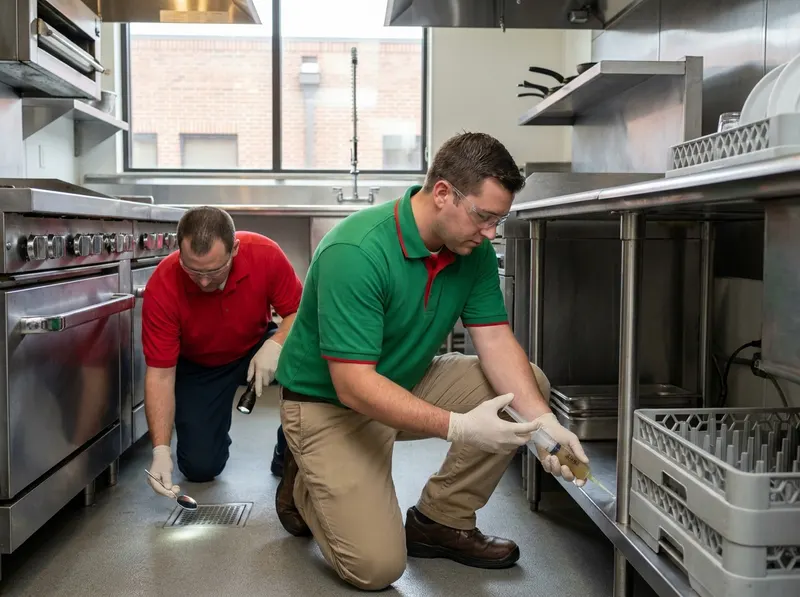
  1. Step 1 Baseline Diagnostic: We inspect grease traps, under-counter refrigeration coils, drop ceiling voids, and plumbing chases to map active infestation nests.
  2. Step 2 Mechanical Sanitation: Kitchen staff and technicians clear organic biofilms from tile perimeters and grease lines using low-moisture biocidal flushing.
  3. Step 3 Drain Remediation: Application of concentrated microbial foaming enzymes digests grease cap build-up inside plumbing hubs where drain flies breed according to guidelines from the CDC Environmental Health Services.
  4. Step 4 Precision Exclusion: High-density silicone sealants and copper mesh close expansion joints, threshold voids, and utility penetrations.
  5. Step 5 Monitored Barrier Maintenance: Strategic placement of tamper-resistant non-toxic pheromone traps tracks population reductions to verify elimination benchmarks against criteria tracked by the Occupational Safety and Health Administration.

Operations based around Fluor Field at the West End, distribution kitchens near Overbrook, and neighborhood eateries in Parkins Mill or Alta Vista navigate distinct pest profiles based on property age. Older brick buildings require aggressive foundation sealing, whereas modern facilities in Gower Estates or Botany Woods often experience moisture-driven pest vectors through overhead delivery portals and municipal water tie-ins. Facilities that coordinate mechanical maintenance with IPM guidelines from the National Pest Management Association minimize down-time, ensure compliance with the NSF International sanitation standards, and adhere to environmental protection standards articulated by the Clemson University Department of Pesticide Regulation and the United States Department of Agriculture.

How much does Commercial Kitchen Sanitation and IPM cost in Greenville?

Small Commercial Kitchen (Under 1,500 sq ft) Baseline Remediation$200 - $375
Standard Restaurant Kitchen (1,501 - 3,500 sq ft) Comprehensive IPM$375 - $650
Large Food Service Facility / Commissary (3,501+ sq ft)$650 - $1,200+
Microbial Trench Drain & Biofilm Remediation (Per Line)$200 - $350

Every job gets a firm, written price after an on-site visit.

Common questions

What sanitation standards govern commercial kitchens in Greenville?
Commercial culinary operations in Greenville adhere to South Carolina DHEC Food Regulations (Regulation 61-25), which mandate strict exclusion of vectors including rodents, flies, and cockroaches through physical barriers and approved non-contaminating IPM procedures.
Does commercial kitchen IPM require signing a 12-month contract in Greenville?
No, commercial kitchen sanitation and IPM programs through MapleHaven Exterminators do not mandate rigid 12-month auto-billing agreements, providing transparent, flexible remediation schedules customized to your kitchen's seasonal load.
How quickly can kitchen treatments be scheduled in Greenville?
Diagnostic inspections and baseline remediation for food service facilities across Greenville can be dispatched within 24 to 48 hours to mitigate active health inspection citations and prevent critical operational shutdowns.
Are the sanitation and IPM treatments safe around food prep surfaces in Greenville kitchens?
Yes, biological drain enzymes, targeted gel micro-injections, and non-volatile insect growth regulators are applied strictly to voids, cracks, and harborage sites away from direct food-contact surfaces in compliance with FDA and EPA mandates.
What is the minimum pricing threshold for commercial kitchen pest control in Greenville?
The starting baseline fee for any commercial food service inspection and targeted treatment is $200, with comprehensive service plans scaled directly to facility square footage and active harborage severity.

Get started today

Tell us about your commercial kitchen sanitation and ipm job in Greenville and we'll send a clear, written quote, usually the same day.

Get your pest control services quote, Greenville

We only use your ZIP to check availability, no spam.