Subterranean termite treatments address the subterranean eastern species that nest within moist red clay soil throughout Greenville County. Structural timber in historic Augusta Road crawlspaces or mid-century ranch…
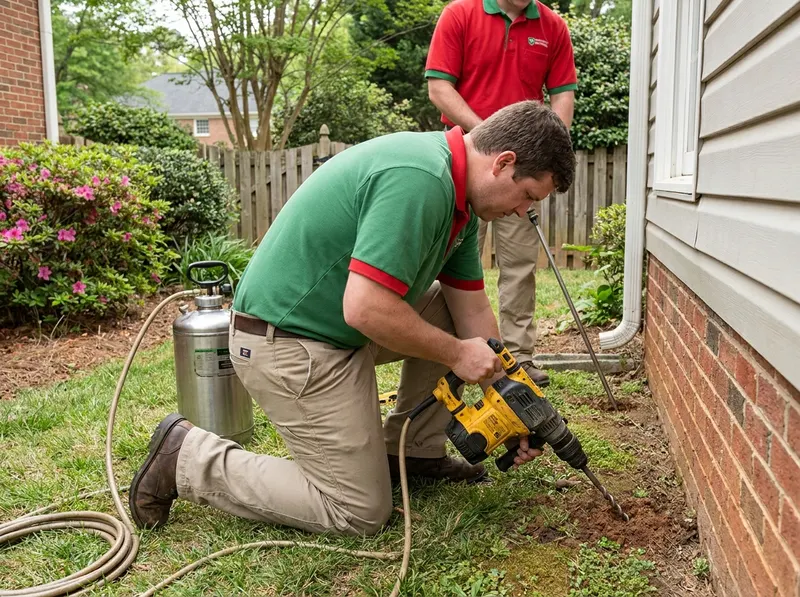
Subterranean termite treatments address the subterranean eastern species that nest within moist red clay soil throughout Greenville County. Structural timber in historic Augusta Road crawlspaces or mid-century ranch foundations in Gower Estates and Botany Woods remains vulnerable when exterior soil interfaces with wood framing. Active infestations require establishing an uninterrupted liquid chemical envelope using non-repellent termiticides such as fipronil, which termites pass through without detection. The colony transfers the active ingredient via grooming habits, achieving total colony collapse within 90 days rather than simply diverting insects to untreated wall cavities. Concrete slab foundations common across North Main and Overbrook require specialized rotary hammer drilling along interior load-bearing partition walls to reach subterranean nests beneath living areas. Homeowners can reach our field office at (864) 215-5213 for dispatch inquiries.
Selecting between perimeter liquid barrier trenching and hexaflumuron baiting stations involves balancing immediate excavation speed against soil composition. Liquid perimeter trenching digs 6 inches wide by 6 inches deep around foundation masonry to saturate soil down to the footings, stopping active entry within days. In contrast, advanced baiting arrays installed every 10 to 15 linear feet suit rocky foothill properties near Paris Mountain State Park or sloped parcels along the Swamp Rabbit Trail where trenching disrupts root systems. The structural trade-off centers on intervention speed versus landscaping impact: liquid trenching halts active feeding inside floor joists within hours, while bait monitoring matrices eliminate parent underground colonies over 60 to 120 days through molting disruption.
Regulatory standards established by the Clemson University Department of Pesticide Regulation govern all subterranean termiticide application rates across South Carolina. Proper application adheres to guidelines from the Environmental Protection Agency to safeguard local groundwater aquifers. Construction framing specifications referenced by the National Association of Home Builders mandate precise separation between raw timber and masonry to stop damp ground contact. When foundation wood rests near damp soil, structural evaluation criteria from the American Society of Civil Engineers help determine compromised load capacities. Environmental soil moisture monitoring methods documented by the United States Geological Survey illustrate how Upstate precipitation drives subterranean swarming events. Technical training protocols supported by the National Pest Management Association inform our trenching procedures. Safe structural drilling practices follow rules from the Occupational Safety and Health Administration. Wood stability benchmarks established by the American Wood Council guide our damage containment metrics. Building code standards maintained by the International Code Council direct subterranean barrier construction. Additionally, biological studies from the Entomological Society of America verify that non-repellent transfer chemistry remains the most reliable mechanism for total colony elimination without requiring long-term lock-in service agreements.
Every job gets a firm, written price after an on-site visit.
Tell us about your subterranean termite treatment job in Greenville and we'll send a clear, written quote, usually the same day.
 MapleHaven Exterminators